Planetary Science
Orbital mechanics #
Orbital parameters #
- Orbital period
- Inclination
- Eccentricity
Simulators #
Heliocentric orbital simulator: https://ssd.jpl.nasa.gov/tools/orbit_diagram.html
Specific simulator for Saturn: https://gravitysimulator.org/solar-system/saturn-and-its-rings-and-major-moons
Rotation parameters #
- Rotation period
- Axial tilt
Celestial coordinates #
- Ascension
- Declination
Gravitational resonance #
Trojan satellites #
Planetary features #
Spectrum #
Albedo #
Peaks of eternal light #
https://en.wikipedia.org/wiki/Peak_of_eternal_light
Permanently shadowed craters #
https://en.wikipedia.org/wiki/Permanently_shadowed_crater
Planetary Topography #
Spheroid #
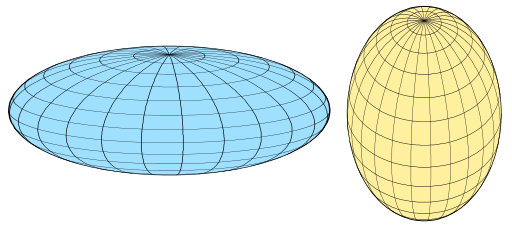
Oblate and prolate spheroids. Source.
A spheroid, also known as an ellipsoid of revolution or rotational ellipsoid, is the surface obtained by rotating an ellipse about one of its principal axes; in other words, an ellipsoid with two equal semi-diameters. A spheroid has circular symmetry.
If the ellipse is rotated about its major axis, the result is a prolate spheroid, elongated like a rugby ball.
If the ellipse is rotated about its minor axis, the result is an oblate spheroid, flattened like a lentil or a plain M&M.
If the generating ellipse is a circle, the result is a sphere.
Due to the combined effects of gravity and rotation, planets are not quite in the shape of a sphere, but instead is slightly flattened in the direction of their axis of rotation.
Quadrangles #
TDB
Distance of the horizon #
Distance to the true horizon from an observer close to the planet’s surface is about \(d \simeq \sqrt{2 h R}\) where h is height above sea level and R is the radius. For instance:
-
On Earth, in standard atmospheric conditions, for an observer with eye level above sea level by 1.70 metres, the horizon is at a distance of about 5 km.
-
On Mars, where R = 3300km, for the same observer the horizon would be at \(d \simeq \sqrt{2*1.7m*3300000m} \simeq 3.5\) km
-
On Europa, where R = 1561km, for the same observer the horizon would be at \(d \simeq \sqrt{2*1.7m*1561000m} \simeq 2.3\) km
Calculator #
Insert the height of the observer and the radius of the planet to obtain the horizon distance, calculated with the formula above.
Radius: km
Distance of the horizon: km
Planetary Geology #
Cold trap #
https://en.wikipedia.org/wiki/Cold_trap_(astronomy)
Solar System #
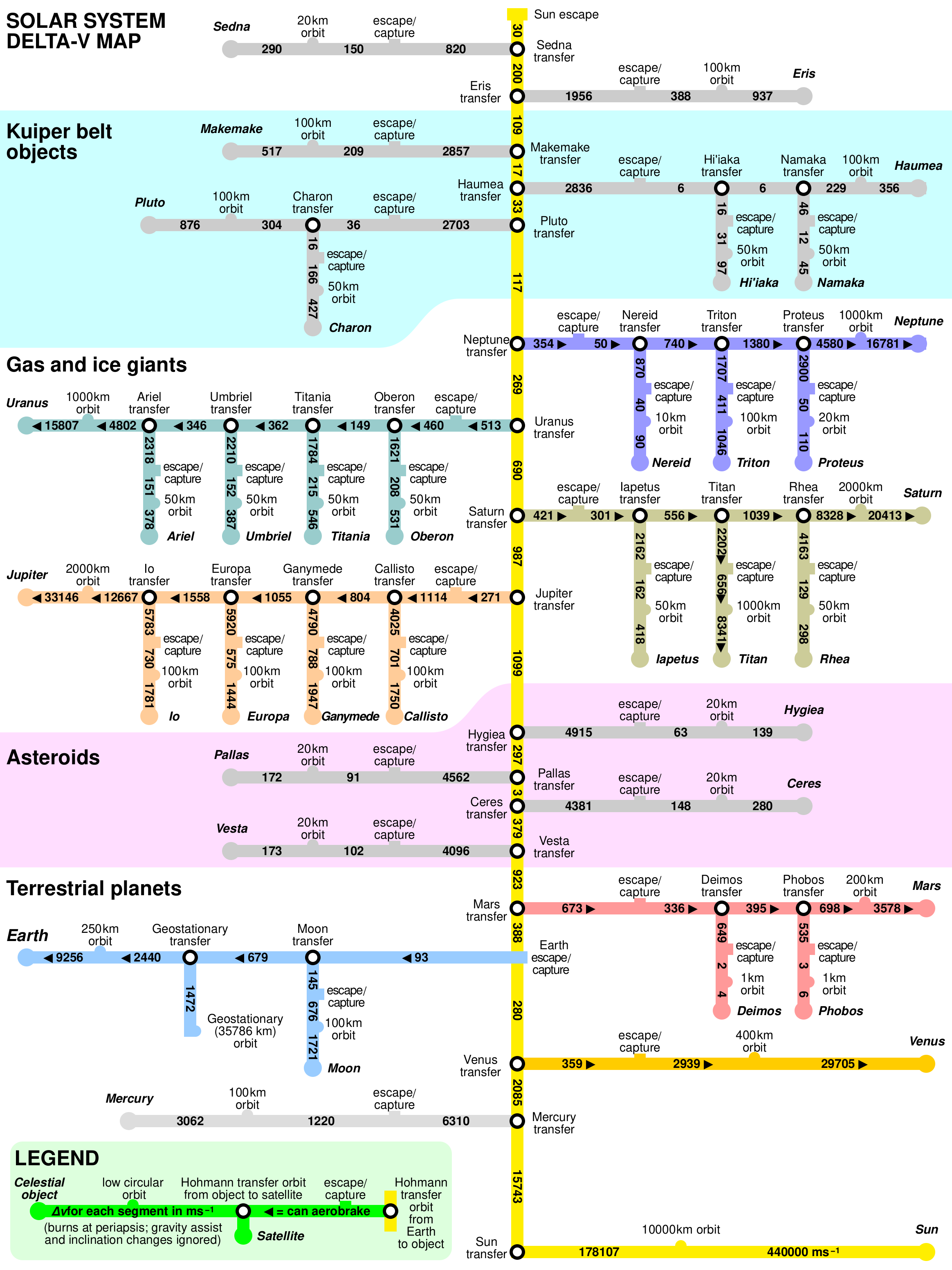
Delta-v requirements for main Solar System bodies #
Coordinates system #
Ecliptic coordinate system #
This spherical coordinate system is uses to specify the position of various orbiting bodies with respect to the Sun [1].
Such coordinate system can also be centered on a specific planet to define the orbits of its moons or satellites, as it’s sometimes done with the Earth.
The name of the coordinates are:
-
If heliocentric (centered on the Sun):
- longitude: l
- latitude: b
- distance: r
-
If geocentric (centered on the Earth or another planet with orbiting satellites):
- longitude: λ (lowercase lamda)
- latitudine: β (lowercase beta)
- distanza: Δ (uppercase delta)
References #
[1] “Ecliptic_coordinate_system” https://en.wikipedia.org/wiki/Ecliptic_coordinate_system.